The London Times
Why gravel cycling is the next big Mamil obsession
By Tom Weijand
- Excerpt from Article -
Gray & Co
Founded by Cari Gray, this is the pinnacle of custom (not just cycling) travel, and may necessitate a redefinition of words like “bespoke” and “luxury”. There is no “classic” trip, Gray says: “We do things all over the world.” Everything is created from scratch by a huge team of experts and logicians. Routes are prepped and mapped weeks in advance, and a “pre-arrival team” may be on the ground for up to two weeks before guests arrive to drive, walk and cycle every inch of the route and check in with every restaurant, hotel and villa. They arrive with a small army of support vehicles from SUVs to bike trucks. Pros and Olympians are flown in, chefs are shuttled around. There’s a cycling team (including mechanics and even paramedics if necessary), as well as a ground team co-ordinating everything off-bike. “Every trip is a huge production behind the scenes,” Gray says.
It costs what it costs, there’s no price list, this is simply zenith level travel planning/organisation for adventure-seeking billionaires.


- From Full Article -
It’s fast, fun and done in beautiful locations, with kit to lust after. Tom Weijand on the best bikes and trips for gravel lovers
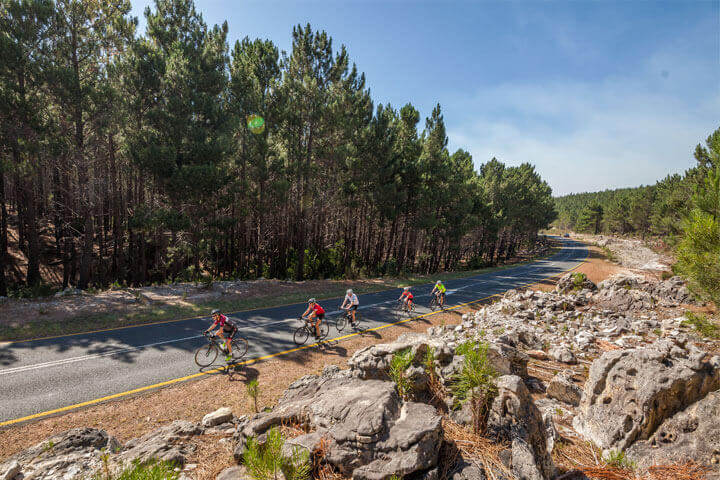
A banker friend said that this year, for the first time, his annual adrenaline ride cycle trip was going to be on gravel rather than road. He’s not alone. Gravel cycling has exploded in popularity in the past decade. It occupies the space between road and mountain-biking and takes in leafy forest tracks, fire roads, long open unpaved roads, woodland paths, public access bridleways and towpaths, even private land with the right permissions. There’s well over 40,000km of gravel track in the UK alone.
There is a consensus that gravel is the safest way to do high-end high-speed cycling. The presence of cars is the single biggest barrier to entry for would-be cyclists, which might explain why so many are flocking to gravel. There are hundreds of races worldwide attracting huge numbers of entries. Such is the demand for places, events are struggling to accommodate the thronging numbers.
The biggest and most prestigious events open to the public are Unbound in Emporia, Kansas; the Traka in Girona Spain; SBT GRVL in Colorado; BWR in California; the Rift in Iceland; Gravel Burn in South Africa; RADL GRVL in Australia; the Gralloch in Scotland; and Dirty Reiver in England. The courses are spectacular, and the beautiful vistas and landscapes you ride through are some of the finest this planet offers — as the British cyclist Maddy Nutt (the winner of this year’s Traka 560 and the Rift, and second at Unbound) bears witness to on her Instagram.
Gravel is also most cycling brand’s most “important” niche, as it has the highest average bike sale price of any discipline. Statistically speaking your next bike will be a gravel bike, which is good news as this year saw a plethora of new gravel bikes released. Out of this group, three stand head, shoulders and torso above the rest.
Factor Elara
Factor tops the bike tables in terms of prestige, rarity and desirability. This, its new Elara, is a compromise-free, singularly focused race bike that draws on the wide-legged aggressive silhouette of its road-going stablemate, the Factor One. Like the One, this Elara is beautiful and built to be the definitive point-to-point race weapon. It is “the fastest bike on the roughest ground”, according to Factor. “Gravel racing has evolved incredibly quickly, becoming faster and more specialised, and Elara is our response to that,” says David Millar, Factor’s chief brand officer. It completes Factor’s three bike gravel range, alongside the Aluto and Sarana, with the Elara developed “with some of the fastest gravel racers in the world… for pure race speed”, according to Millar.
It absolutely looks and feels the part. It is long and low, which is great for aerodynamics but means riders must have a reasonably athletic suppleness. At speed the Elara feels reactive, with the urgency of a road bike, a result of its short chainstays (423 mm) and comparatively steep head angle. Its unique “planar” fork legs and deep aerodynamic sculpting yield a gravel bike whose aero efficiency is on par with modern road bikes, according to its maker.
As you press hard into the cranks, you’ll immediately notice a solidity to the bottom bracket area. It’s massively oversized, creating a rigid shell with the unflexing resoluteness of a carbon-fibre box girder. The 57mm tyres means that speed, comfort and control can be achieved over the harshest and most competitive terrain. The finishing kit is particularly attractive and performative, the colour-matched seatpost disproportionally epic and the Black Inc Sixty Four gravel racing wheelset (which has a depth of 64mm) bang on the gravel racing trend, with a broad 30mm internal width. The bike has been teased at gravel races for a while, first at the Traka, then at Unbound. It won at Iceland’s Rift 200 under Haley Smith. In prototype form, it has clocked up 13 elite wins and could go home with you for £11,000 in its top-tier, SRAM Red XPLR guise.
Giant Revolt Advanced SL 0
The Advanced Revolt SL 0 is Giant’s top-tier gravel machine. It’s nearly to the millimetre as long and as low as the Elara, and its purpose is to win races. Its head-tube angle is about half a degree slacker, and its chainstays around 10mm longer (depending on size), which means it feels stable and planted, inspiring confidence through the corners.
Giant is one of cycling world’s foremost authorities on carbon fibre, and the wizards there have done something remarkable with the Revolt. They’ve used a proprietary formulation and layup of high-modulus carbon fibre, with carbon nanotube technology. In typical Giant fashion it feels fantastic to ride. Its one-piece moulding technology is arguably the best in the business, resulting in a bike that is stiff at the bottom bracket, direct and immediate, while also having the forgiving suppleness of an endurance bike.
The “engineered compliance”, according to Giant’s retail manager, Rob Lyne (in reference to its ability to absorb vibrations and bumps), “offers comfort while retaining stiffness for power transfer”. Gravel racing has become more prominent, more competitive and faster so Lyne says that Giant has distilled its “design and engineering knowledge… into the absolute lightest, fastest and aero optimised bike for gravel racing at the highest level”. The new Revolt has been on a diet too, and this fully fledged gravel race bike with large 45mm tyres weighs as little as 7.2kg, a figure not out of place in a pro road race. This featheriness is an addictive and rewarding ride. It feels incredibly solid and dependable for something so light and airy, and just disappears under you.
Giant is the world’s largest bike manufacturer, and has brought its titan scale into sharp focus on gravel. The Revolt is its 1966 GT40 moment. The SL 0 is yours for a hair under £10,000.
The Specialized S-Works Crux 5
Completing the trio is the new Specialized S-Works Crux 5. This is a top-tier SRAM Red XPLR build that has become the de facto choice for those serious about their gravel. It was officially launched a few days before Unbound this year, with a frankly unreasonable amount of success. In the men’s race, the S-Works hoovered up first, second, third and fifth places, and in the women’s race first and second, which must have left the Specialized marketing team twiddling their thumbs.
Geometry-wise, it’s a few millimetres higher than the other two bikes, several millimetres more compact and about a degree more slack at the headtube, though it retains punchy 425mm chainstays for that direct connection to the ground. What can one say about the S-Works that its racing results don’t prove better? Specialized focuses on what it calls Time To Finish (TTF). This is a system-level testing heuristic used in Formula 1 to optimise the bike for the fastest race time, not just on individual metrics like weight or aerodynamics alone (although of course it is claimed to be the lightest). It is based on real data, not just theories.
Specialized has concluded that the new bike would have saved Sofía Gómez Villafañe almost ten minutes (over her old Crux) on her Unbound 2025 time. In typical S-Works fashion, there’s no flourish spared, with a decadent CeramicSpeed bottom bracket and headset, and an unimprovable spec list. It’s an engaging ride and, like its road-going sibling, the Tarmac SL 9, it’s disturbingly easy bike to ride quickly. With clearance for 55mm tyres, you’ll be glad of the extra grip and control when it becomes time to shed that accumulation of speed. It’s yours for a whisper under £12,000.
Gravel Travel
Once you’ve bought your bike, you might want to treat it to a fancy holiday. Companies specialising in luxury riding, are rapidly adding gravel to their quiver of offerings. Here are a few of the best.
DuVine Cycling
DuVine blends a white-glove cycling service with fastidious attention to accommodation, food and wine. It operates across 20 countries from Girona, Spain, to New Zealand, and specialises in private villas and bespoke private tours, where curated routes, two local guides and a support van will accompany you on adventures.
According to Mia Liefeld, the director of marketing at DuVine, what singles out its luxury experiences are the combination of premium bikes from Colnago and BMC, its carefully selected luxury accommodations and its unique focus on wine and dining. Its finest gravel trips include options like the Colnago Tuscany tour, which takes in Italy’s famous strade bianche (white roads) and starts at about $10,000 per person. Its private villa portfolio spans Provence to California to Tuscany, and custom itineraries can also be built around this.
InGamba
InGamba’s distinction, according to its chief operating officer Jon Moss, “is that it operates like a World Tour team”. Its hallmark are the private trips that may run well into six figures for a group of ten. It was started by the former World Tour rider Joao Correia and provides perhaps the most authentic pro experience. The guides are comprised of former pro tour riders and Olympic medallists, they provide soigneurs (support staff) who’ve taken care of Grand Tour winners, and their partners look like a list of World Tour sponsors. They provide a daily massage post-ride, custom kit (washed daily), and soigneurs to wash your bike daily. Follow cars, driven by professional mechanics, will tail the group to be on hand should you be struck by a nasty puncture or worse. Their European destinations are broad and deep, with a portfolio spanning Tuscany, the Dolomites, the Stelvio, Provence, Spain and beyond.
Gray & Co
Founded by Cari Gray, this is the pinnacle of custom (not just cycling) travel, and may necessitate a redefinition of words like “bespoke” and “luxury”. There is no “classic” trip, Gray says: “We do things all over the world.” Everything is created from scratch by a huge team of experts and logicians. Routes are prepped and mapped weeks in advance, and a “pre-arrival team” may be on the ground for up to two weeks before guests arrive to drive, walk and cycle every inch of the route and check in with every restaurant, hotel and villa. They arrive with a small army of support vehicles from SUVs to bike trucks. Pros and Olympians are flown in, chefs are shuttled around. There’s a cycling team (including mechanics and even paramedics if necessary), as well as a ground team co-ordinating everything off-bike. “Every trip is a huge production behind the scenes,” Gray says.
It costs what it costs, there’s no price list, this is simply zenith level travel planning/organisation for adventure-seeking billionaires.
finis.